Rising ESA Letter Submissions Challenge Texas Landlords This March

The ability to get an emotional support animal letter online has never been more consequential for Texas renters than it is in March 2026. Across the state's largest cities and rapidly growing suburbs, landlords are receiving a surge of ESA accommodation requests that is forcing many of them to confront federal fair housing law in ways they were not prepared for. Property managers in Houston, Dallas, Austin, San Antonio, and Fort Worth are all reporting a significant uptick in the number of tenants submitting ESA letters and requesting exemptions from no-pet policies. For some landlords, this is a new and unfamiliar challenge. For the tenants making these requests, it is the exercise of a federal right that Texas law also supports.
This report looks at what is driving the March 2026 surge in ESA letter submissions across Texas, how the state's specific legal environment shapes both tenant rights and landlord obligations, and what the growing volume of accommodation requests means for the future of animal-friendly housing policy across the state.
Texas as a High-Growth Rental Market With Rising Mental Health Needs
Texas has experienced extraordinary population growth over the past decade, and much of that growth has landed in the rental market. The state's largest cities now rank among the most competitive rental markets in the southern United States. Houston, Dallas, and Austin in particular have seen consistent rent increases over the past several years, driven by in-migration from higher-cost states, a robust job market, and a significant inventory gap between supply and demand in affordable rental housing.
At the same time, Texas carries one of the largest mental health burden figures in the country by total population. The sheer number of Texans managing anxiety, depression, PTSD, and related conditions is substantial, and the infrastructure for accessing mental health care, particularly in rural areas and among uninsured or underinsured residents, has historically lagged behind other large states. Many Texans managing real mental health conditions have done so without formal clinical support, and the growth of accessible telehealth platforms has opened that support system to many people who could not previously access it.
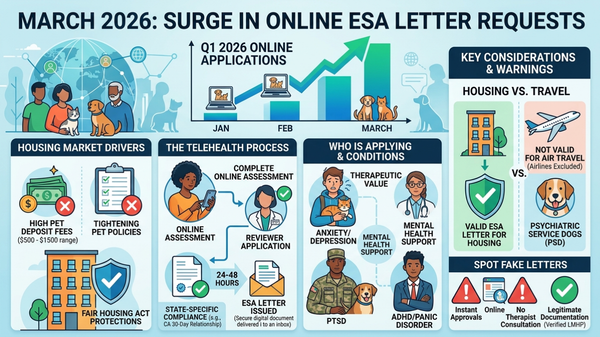
The combination of a large and growing renter population, high rates of mental health conditions, improved access to telehealth evaluations, and increased public awareness of ESA housing rights has created the conditions for exactly the kind of surge in ESA letter submissions that landlords across Texas are experiencing in March 2026. This is not a wave of fraud or abuse. It is a population exercising rights they are entitled to, many of them for the first time.
HB 4164: Texas's Anti-Fraud Law and What It Means for Documentation Quality
In 2023, Texas passed House Bill 4164, which created specific penalties for the fraudulent misrepresentation of emotional support animals and service animals. Under HB 4164, a person who knowingly misrepresents an animal as an ESA or service animal in order to obtain housing accommodation faces a civil fine of up to one thousand dollars and may be required to complete thirty hours of community service. Businesses that sell fraudulent ESA documentation are also subject to penalties under the bill.
The passage of HB 4164 had a dual effect on the Texas ESA landscape. On one hand, it targeted the fraudulent documentation market and sent a clear message that Texas would not tolerate abuse of the accommodation process. On the other hand, it raised the bar for documentation quality across the board. Texas landlords who were already skeptical of some online ESA letters became more so after the bill passed, and property managers began scrutinizing documentation more carefully for signs of legitimacy.
This shift in landlord behavior has actually benefited tenants who obtain their documentation through legitimate services. When a letter is issued by a licensed Texas mental health professional, references a genuine clinical evaluation, includes verifiable credentials, and is formatted to meet the standards that a legally informed housing provider expects to see, it passes the kind of scrutiny that HB 4164-era landlords now apply. Letters that fail that scrutiny tend to be the ones from services that were never conducting real evaluations in the first place.
Understanding the full scope of Texas ESA law, including the specific protections it provides and the penalties that now apply to misrepresentation, is essential for any Texas renter pursuing accommodation. The detailed breakdown of Texas ESA laws including the HB 4164 fraud penalties explains both tenant rights and the legal framework landlords are required to operate within.
Houston: High Volume, High Scrutiny
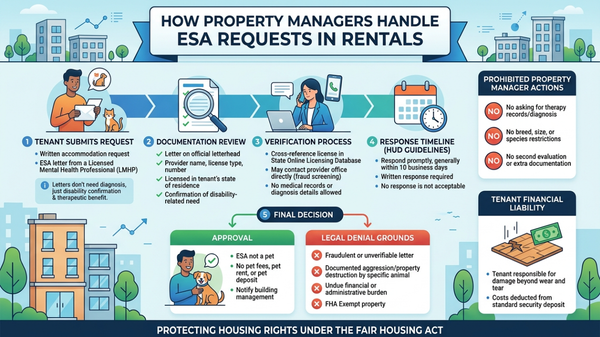
Houston's rental market is enormous by any measure, and its ESA letter submission volume reflects that scale. The city and its surrounding metropolitan area are home to millions of renters spread across thousands of apartment complexes, many of them managed by large national property management companies with in-house legal teams. These companies have compliance departments that are well versed in fair housing law, and when an ESA letter comes in, it goes through a review process that is considerably more rigorous than what a small private landlord might apply.
For Houston tenants, this means that documentation quality is not just helpful. It is necessary. A letter with missing credentials, issued by an out-of-state clinician, or formatted in a way that signals it came from a mass-production service will likely be flagged and rejected by a compliance team that has reviewed thousands of ESA letters. A letter that carries verifiable in-state credentials, reflects a genuine evaluation process, and uses clinically precise language will move through that same review process without issue.
The March 2026 surge in Houston is also being driven by tenants in newer high-rise developments in the Midtown, Montrose, and Inner Loop areas, where rents are high, pet policies are strict, and landlords have become particularly attentive to accommodation requests of all kinds. For these tenants, the stakes of getting the documentation right are immediately financial in addition to legal.
Austin: A Market Where ESA Rights Collide With Tech Industry Housing Pressure
Austin's rental market has been one of the most volatile in the country over the past several years. The city experienced a dramatic run-up in rents between 2020 and 2023, followed by a partial softening as new inventory came online, and has since stabilized at levels that remain significantly higher than pre-pandemic norms. For renters in Austin, particularly those in the technology sector who moved to the city during the remote work boom, housing costs remain a central source of financial stress.
The Austin ESA request surge in March 2026 is visibly correlated with the mental health pressures of that financial stress combined with the isolation that many remote workers experience. Anxiety and depression rates among Austin's tech-adjacent renter population are notable, and the concentration of younger renters in this demographic, many of whom are more comfortable with telehealth and online processes than older generations, has contributed to a rapid uptake of legitimate ESA documentation services.
Austin also has a significant university population, with students at the University of Texas and several other institutions making up a substantial share of the city's renter base. University housing and off-campus rental properties in Austin are both seeing elevated ESA letter submission rates, and the specific documentation requirements for university housing, which often involve different submission procedures than private landlords use, add another layer of complexity for student renters.
Dallas and Fort Worth: Corporate Landlord Complexity in a Sprawling Market
The Dallas-Fort Worth metroplex is one of the largest urban rental markets in the country, and its housing stock is dominated by large apartment communities owned by institutional landlords and real estate investment trusts. These corporate landlords have standardized accommodation review processes, and when ESA letters are submitted in their markets, they tend to be processed through centralized compliance functions rather than handled at the property level.
For tenants in the DFW area, this corporate landlord structure creates a specific challenge. A rejection from a centralized compliance team carries more institutional weight than a pushback from a small private landlord, and the appeals process is more formal. Tenants who receive a rejection need to know not just that their rights exist but exactly how to invoke them in writing, what documentation to resubmit or supplement, and what formal complaint channels are available if the rejection is not lawfully justified.
The March 2026 surge in DFW is also being driven in part by tenants who received letters from services that did not conduct genuine evaluations and are now seeking replacement documentation after a corporate landlord's compliance team rejected their original letter. For these tenants, getting the second letter right is more important than getting the first one was, because they are now dealing with a landlord who has already seen a document they considered non-compliant.
For Texas tenants in any major metro who want to understand the cost landscape and why legitimate ESA letters in Texas can be more accessible than in states with additional documentation requirements, the analysis of why Texas ESA letters are more affordable than in other states provides a useful breakdown of what drives pricing differences and what a legitimate letter at a reasonable price actually looks like.
What Texas Landlords Are Getting Wrong About the Surge
The most common error Texas landlords are making in response to the March 2026 surge is treating the volume of ESA letter submissions as inherently suspicious. When a property sees more accommodation requests than it did two years ago, the instinctive response from some property managers is to assume that a significant portion of them must be fraudulent and to apply heightened skepticism to all of them. This response, while understandable from a management perspective, creates significant legal exposure for landlords who apply that skepticism in ways that cross into disability discrimination.
Under the Fair Housing Act, a landlord must evaluate each ESA accommodation request individually. They cannot deny a request because they have received many similar requests recently. They cannot apply a heightened documentary burden to ESA requests that they do not apply to other accommodation requests. And they cannot assume fraud based on the fact that a letter was obtained through an online service rather than from a traditional therapist. The legitimacy of the letter turns on the credentials of the clinician and the authenticity of the evaluation process, not on the channel through which the tenant obtained it.
Texas landlords who want to protect themselves from both fraud and fair housing liability need to learn how to evaluate ESA letters correctly rather than either accepting all of them without scrutiny or rejecting them based on suspicion alone. The standard is consistent: verify the clinician's Texas license, confirm the letter contains all required elements, and evaluate the accommodation request individually on its merits.
The Path Forward for Texas Tenants in 2026
For Texas renters who are part of the March 2026 surge in ESA letter requests, the most important thing to understand is that the legal foundation for their rights is solid, the documentation process is more accessible than it has ever been, and the quality of that documentation is what determines whether the process ends with approval or rejection.
Texas follows the federal fair housing standard without the additional 30-day relationship requirement that California and several other states have enacted. This means a Texas renter can complete a legitimate online evaluation and receive a valid ESA letter through the same process that works in most other states, as long as the clinician conducting the evaluation holds an active Texas license and the letter is prepared to meet the standards that Texas's increasingly scrutinizing landlords apply.
RealESALetter.com matches Texas clients specifically with clinicians licensed in Texas, conducts genuine clinical evaluations, and produces documentation that reflects current Texas law. For tenants navigating the challenges of the March 2026 rental market, whether they are in Houston, Dallas, Austin, San Antonio, or anywhere else in the state, the full guide to getting an ESA letter in Texas and what the process involves provides a step-by-step walkthrough of exactly what to expect and how to move through the process efficiently.
A Surge That Reflects Real Need, and Real Rights
The March 2026 surge in ESA letter submissions across Texas is not a legal or administrative inconvenience for the state's housing market. It is a signal that a large population of renters managing genuine mental health conditions have become more aware of their rights and more capable of accessing the documentation that allows them to exercise those rights. That is how a functioning legal framework is supposed to work.
The challenge for Texas's housing market going forward is to develop the knowledge and the processes to handle this volume of accommodation requests lawfully and fairly, neither accepting fraudulent documentation uncritically nor denying legitimate requests out of skepticism or inconvenience. For tenants, the challenge is to obtain documentation that is good enough to survive that scrutiny. Both challenges have practical solutions, and the legal framework that governs them is clear.