How to Ask Your Doctor for an ESA Letter (Without Feeling Awkward)

Bringing up mental health with a doctor is uncomfortable for a lot of people, and asking for a legitimate emotional support animal letter on top of that can feel like one layer too many. Many people avoid the conversation entirely, either assuming their doctor will say no or not knowing how to start. Both of those outcomes are avoidable with a bit of preparation.
The truth is that licensed mental health professionals and physicians hear requests for an emotional support animal letter regularly. It is a clinical request that fits within the normal scope of mental health treatment. The awkwardness most people feel before the appointment rarely matches what the conversation is actually like once it begins.
This guide breaks down exactly who can write a legitimate emotional support animal letter, how to prepare before the appointment, what to say once the conversation starts, and what to do if the first provider declines. Every step is laid out plainly so that anyone going through this process for the first time knows what to expect.
Who Can Actually Write a Legitimate Emotional Support Animal Letter
Not every healthcare provider can write a legitimate emotional support animal letter. Federal guidelines under the Fair Housing Act and HUD require that the letter come from a licensed mental health professional or, in some cases, a licensed medical doctor who has evaluated the person's mental or emotional health. Knowing which providers qualify before scheduling an appointment saves time and avoids starting the process with someone who cannot legally issue the documentation.
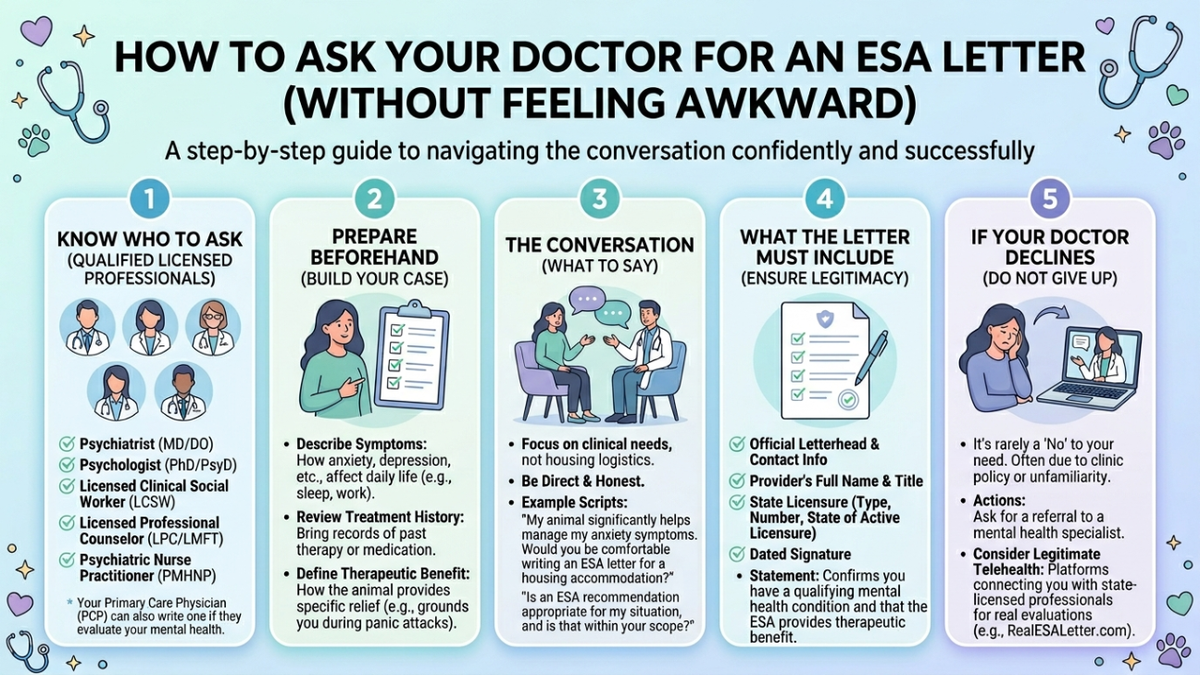
The most common providers who issue emotional support animal letters are licensed clinical social workers (LCSWs), licensed professional counselors (LPCs), licensed marriage and family therapists (LMFTs), licensed psychologists, and psychiatrists. These professionals are trained specifically in mental health evaluation and are the most familiar with what a valid letter requires. Understanding who can write an ESA letter helps identify the right provider from the start.
Primary care physicians (PCPs) can also write a legitimate emotional support animal letter if they have evaluated the patient's mental or emotional health and feel comfortable making the recommendation. Many PCPs decline due to limited familiarity with ESA law, time constraints, or a preference to refer to a mental health specialist. A declined request does not close the door. It simply means finding a provider with more relevant expertise.
Licensed providers who can issue a valid emotional support animal letter:
- Psychiatrists (MD or DO): medical doctors who specialize in mental health, can prescribe medication, and carry high clinical credibility when issuing ESA documentation
- Licensed psychologists (PhD or PsyD): doctoral-level clinicians trained in psychological assessment and diagnosis, among the most commonly recognized providers for ESA letters
- Licensed clinical social workers (LCSW): master's-level therapists who conduct evaluations and provide therapy, fully qualified to write ESA letters when clinically appropriate
- Licensed professional counselors (LPC) and licensed marriage and family therapists (LMFT): state-licensed mental health professionals who can assess qualifying conditions and issue documentation
- Psychiatric nurse practitioners (PMHNP): advanced practice nurses specializing in mental health who can diagnose and treat mental health conditions
How to Prepare Before the Appointment
Walking into an appointment without preparation makes the conversation harder than it needs to be. A few minutes of preparation before the visit makes it significantly easier to communicate what is needed, why it is needed, and how the provider can help. This is about being clear enough that the provider has the information required to make a clinical decision.
Start by thinking through the mental health symptoms or conditions that are affecting daily life. These do not need to be diagnosed already. The provider's job is to assess whether a qualifying condition exists. Describing specific symptoms, such as difficulty sleeping, persistent anxiety, social withdrawal, or panic attacks, gives the provider concrete clinical information to work with. Vague descriptions do not give the provider enough to make a confident recommendation for a legitimate emotional support animal letter.
If there is existing treatment history, such as prior therapy notes, medication records, or previous diagnoses, bringing that to the appointment strengthens the case. A provider who sees that a mental health condition has already been identified and treated has a much clearer basis for recommending an ESA as part of ongoing support. It also shortens the evaluation process because the provider does not need to start from scratch.
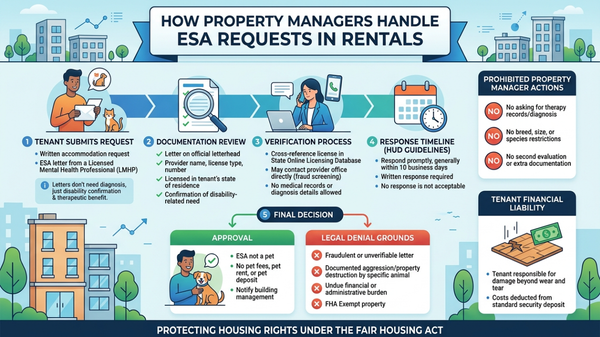
The Fair Housing Act ESA protections outline what providers need to establish before issuing documentation. Reviewing these requirements before the appointment helps frame the conversation around clinical criteria rather than personal preference.
What to prepare before asking for an emotional support animal letter:
- A clear description of the symptoms affecting daily functioning, including how long they have been present and how they affect sleep, work, relationships, or general wellbeing
- Any relevant treatment history, including prior therapy, medication, or mental health diagnoses, even if treatment happened years ago
- A brief explanation of how the animal provides specific relief, such as reducing anxiety during panic attacks, improving grounding, or supporting daily routine and motivation
- Questions about the provider's experience with ESA letters to gauge whether they are comfortable issuing documentation
What to Say During the Appointment
The biggest reason people feel awkward asking for a legitimate emotional support animal letter is not knowing how to introduce the topic. The conversation does not need to be elaborate. It needs to be direct, honest, and grounded in the actual symptoms being experienced. Providers respond much better to clinical descriptions than to housing logistics, so leading with the mental health context before mentioning the letter is the most effective approach.
A direct opening works well: explain the ongoing struggle with a specific condition such as anxiety, depression, or PTSD, and that an emotional support animal has provided noticeable symptom relief. Then ask whether the provider would feel comfortable writing a legitimate emotional support animal letter to support a housing accommodation request. That framing keeps the conversation clinical and positions the letter as part of a treatment plan rather than a workaround for pet policies.
Some people worry the provider will think they are exaggerating symptoms or seeking the letter for fraudulent reasons. That concern is worth setting aside. Providers who work in mental health understand that emotional support animals have genuine therapeutic value. Anxiety, depression, PTSD, and panic disorder are exactly the types of qualifying conditions that regularly support an ESA recommendation. Describing symptoms honestly is the most effective way to have that recommendation made on solid clinical ground.
Phrases that open the conversation naturally:
- "I have been dealing with anxiety and depression for some time, and my animal significantly helps me manage symptoms. Would you be comfortable writing an emotional support animal letter for a housing accommodation?"
- "We have talked about my mental health before. Would you think an ESA recommendation would be appropriate for my situation, and is that something you can put in writing?"
- "I am not looking for a service animal certification. I just need a letter confirming I qualify for an emotional support animal under the Fair Housing Act. Is that within your scope?"
- "My animal has been really helpful with my PTSD symptoms, and I would like to keep them with me when I move. Could we talk about whether an ESA letter is appropriate for my situation?"
What to Do If the Doctor Says No
A provider who declines to write an emotional support animal letter is not closing the door permanently. It usually means the provider lacks sufficient familiarity with ESA law, does not yet have a clear enough clinical picture, or the clinic has a policy against writing ESA letters. None of these reasons are a verdict on whether someone qualifies.
When a primary care physician or current therapist declines, the next step is finding a provider who specializes in mental health evaluations and ESA documentation. Understanding who can write an ESA letter makes it easier to identify the right type of provider for a second attempt. Telehealth platforms that connect clients with licensed mental health professionals in their state are often the most accessible option, particularly for people who do not already have an established relationship with a psychiatrist or psychologist.
It is also worth asking the declining provider for a referral. A PCP who will not write the letter may refer the patient to a licensed psychologist or LCSW who specializes in mental health treatment. That referral creates a warm introduction to a provider better positioned to conduct the evaluation and issue the documentation. It also creates a record of continuity of care that can strengthen the clinical case during the evaluation.
Options when a doctor declines the request:
- Ask for a referral to a licensed mental health professional, such as a psychologist, psychiatrist, or LCSW, who can conduct a proper evaluation and issue the letter
- Use a telehealth platform that employs state-licensed mental health professionals specifically experienced with ESA evaluations and documentation
- Schedule a dedicated mental health appointment rather than trying to add the ESA request at the end of a general checkup, since providers are more likely to engage thoroughly when mental health is the stated purpose of the visit
- Research whether the provider's decline was based on clinic policy or clinical judgment, as a policy-based decline does not reflect on the validity of the request
What Happens After the Provider Agrees
Once a provider agrees to write a legitimate emotional support animal letter, a few practical details are worth confirming before leaving the appointment. The letter needs to contain specific information to be accepted by landlords, and not every provider who agrees to write one is familiar with exactly what it must include. Asking a few quick questions at the end prevents having to return for corrections.
Confirm that the provider will include their full name, license type, license number, and state of active licensure on the letter, written on official letterhead with direct contact information so landlords can verify it. Can a therapist write an ESA letter that meets all these requirements? Yes, but only if they hold an active state license and have conducted a genuine clinical evaluation. Making sure the issuing provider knows what the letter must contain prevents having to return for corrections.
Once the letter is received, check it against a standard checklist before submitting it to any housing provider. Look for the license number, provider contact information, official letterhead, a dated signature, and a statement that the applicant has a qualifying mental health condition and would benefit from an emotional support animal. Any missing element gives a landlord grounds to reject the request, and getting it corrected is much easier before submission than after a rejection.
What to confirm with the provider before the letter is written:
- The letter will include the provider's license number, license type, and state of active licensure alongside their full name and direct contact information
- The letter will be written on official professional letterhead and will include the date of issuance and the provider's signature
- The provider understands that landlords may contact their office directly to verify the letter and that the provider will confirm authorship if contacted
- The letter will state that the individual has a qualifying mental health condition and that the emotional support animal provides therapeutic benefit
When Telehealth Is a Better Option Than Your Own Doctor
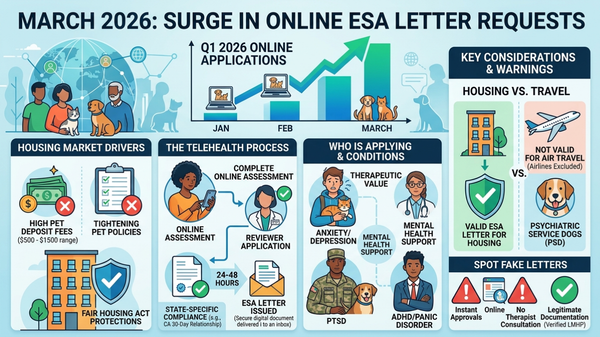
For many people, asking a current provider for a legitimate emotional support animal letter is the right first step. But for those without an existing therapist, whose PCP has limited mental health expertise, or who live in an area without accessible mental health specialists, telehealth is a more practical starting point. Telehealth ESA evaluations are legally valid when conducted by a licensed mental health professional in the applicant's state and are faster to access than in-person appointments.
The key difference between a legitimate telehealth ESA provider and a scam platform is whether a real licensed professional actually evaluates the applicant before any emotional support animal letter is issued. Platforms that skip the consultation and generate documentation through automated forms are not providing a legitimate emotional support animal letter at all. A valid telehealth process involves a real consultation with a state-licensed provider, a clinical assessment of the qualifying condition, and documentation that includes all required credentials.
RealESALetter.com connects applicants with licensed mental health professionals in all 50 states, conducts genuine telehealth evaluations before issuing any letter, and complies with state requirements including the 30-day relationship period in California, Oregon, Arkansas, Iowa, Louisiana, and Montana. For anyone declined by their own provider or without an established mental health provider to approach, the telehealth route through a compliant platform removes most barriers to valid documentation.
Reasons telehealth may be a better fit than approaching a current provider:
- No existing therapist or mental health provider relationship means starting from scratch either way, and telehealth is faster to access than building a new in-person relationship
- Current PCP has limited mental health expertise or has already indicated discomfort with writing ESA letters due to clinic policy or unfamiliarity with the process
- Privacy preference: some people prefer discussing mental health conditions with a provider they have not met in another context, particularly when asking about a condition for the first time
- State requirements for provider relationships vary, and telehealth platforms familiar with ESA letter expiration guidelines and state laws ensure compliance
Frequently Asked Questions
Can a general practitioner write a legitimate emotional support animal letter?
Yes, a primary care physician can write a legitimate emotional support animal letter if they have evaluated the patient's mental or emotional health and feel comfortable making the recommendation. Many PCPs decline due to limited familiarity with ESA law or a preference to refer patients to mental health specialists. A declined request does not mean the person does not qualify. It means finding a provider with more specific mental health expertise such as a licensed psychologist, LCSW, or psychiatrist.
What mental health conditions qualify for an emotional support animal letter?
Qualifying conditions include any diagnosable mental or emotional health condition that significantly impacts daily functioning. Common qualifying conditions include generalized anxiety disorder, major depressive disorder, PTSD, panic disorder, OCD, bipolar disorder, and social anxiety disorder. The provider does not need to disclose the specific diagnosis on the emotional support animal letter. They only need to confirm that a qualifying condition exists and that an ESA is part of the person's therapeutic support plan.
How long does it take to get a legitimate emotional support animal letter after asking a provider?
For most states, a provider can issue a legitimate emotional support animal letter within 24 to 48 hours after a clinical evaluation. In California, Oregon, Arkansas, Iowa, Louisiana, and Montana, state law requires a minimum 30-day client-provider relationship before a letter can be issued. Applicants in those states should begin the process at least five weeks before needing the documentation. Understanding ESA letter expiration guidelines helps plan renewal timing as well.
Does the provider need to know the applicant well before writing the letter?
Federal law does not require a specific length of relationship before a provider can write an emotional support animal letter in most states. The provider does need to conduct a genuine clinical evaluation. In California, Oregon, Arkansas, Iowa, Louisiana, and Montana, state law requires a 30-day client-provider relationship and at least two consultations. Outside those states, a provider who conducts a thorough first evaluation can legally issue the letter at the conclusion of that evaluation.
What if a person feels too nervous to bring up the topic with their doctor?
That hesitation is extremely common. Preparing a short, direct opening statement before the appointment removes most of the uncertainty. Telehealth platforms that specialize in ESA evaluations also offer a lower-stakes way to discuss mental health with a provider who understands the therapeutic value of emotional support animals. Many people find it easier to speak candidly with a provider they have not previously met in another context, especially for a first conversation about a mental health condition.
Do I need a diagnosis before asking for an ESA letter?
No, a prior diagnosis is not required. The provider's role during the evaluation is to assess whether a qualifying condition exists. If the provider determines that a diagnosable condition is present and that an emotional support animal would provide therapeutic benefit, they can issue the letter without requiring that the patient has previously been diagnosed by another provider.
Will my doctor think I am just trying to avoid pet fees?
Providers who understand mental health care recognize that emotional support animals have legitimate therapeutic value. Describing specific symptoms and how the animal helps manage them keeps the conversation focused on clinical need rather than housing logistics. Most providers respond positively when the request is framed around mental health treatment rather than pet policies.
Final Thoughts
Asking a doctor or therapist for a legitimate emotional support animal letter is a clinical request that fits within the normal scope of mental health care. Providers who work with mental health patients hear these requests regularly, and those who are well-positioned to help will engage with it thoughtfully. The discomfort most people anticipate rarely matches the actual conversation.
Preparation makes the biggest difference. Knowing which providers are qualified, describing symptoms clearly, and having a simple opening statement removes the two biggest obstacles: not knowing who to ask and not knowing what to say. For anyone who encounters a declined request or lacks access to a qualified in-person provider, telehealth remains a fully valid path to a legitimate emotional support animal letter: a real licensed professional, a genuine evaluation, and documentation that holds up when a landlord reviews it.
The Fair Housing Act ESA protections exist to ensure that people with disabilities can live with their support animals regardless of pet policies. Understanding these protections makes it easier to advocate for the accommodation with confidence. Whether through an existing provider or a telehealth platform like RealESALetter.com, the goal remains the same: documentation from a licensed professional that confirms a genuine therapeutic need.