How RealESALetter.com Is Helping Shape the Future of ESA Policy in America
ESA policy in America is changing faster than most people realize. New federal guidance, shifting state laws, and a growing number of fraudulent letters have all pushed the conversation around emotional support animals to a turning point. In the middle of all this change, people who genuinely need an ESA still have to find a way to get proper documentation, and that is where working with a reliable online therapist for esa letter evaluations has become not just convenient but essential. RealESALetter.com has been at the center of this shift, and the way it operates is quietly helping define what legitimate ESA services should look like going forward.
The emotional support animal space has had a complicated reputation. For years, scam websites offered instant letters with no real evaluation, no licensed professional, and no legal standing. That flood of fraudulent documentation created problems for landlords, housing providers, and, most importantly, for the people who genuinely needed their ESAs recognized. RealESALetter.com has taken a different path, and that path is starting to influence where the entire industry is headed.
Understanding the ESA Policy in 2025 and 2026
Federal ESA policy has gone through meaningful changes in recent years. The most significant recent development came in September 2025, when the U.S. Department of Housing and Urban Development withdrew several key guidance documents that had served as the practical rulebook for ESA requests in housing for the previous five years.
The National Apartment Association reported that HUD's September 17, 2025 memorandum withdrew FHEO Notice 2020-01 and FHEO Notice 2013-01, two documents that had provided detailed instructions for how landlords and housing providers should handle ESA accommodation requests. HUD stated that the withdrawn guidance went beyond what the Fair Housing Act actually requires and created compliance burdens not found in the statute itself.
This withdrawal did not eliminate ESA rights. The Fair Housing Act itself remains unchanged. People with qualifying disabilities can still live with their emotional support animals in no-pet housing, and landlords are still required to make reasonable accommodations. But the removal of detailed federal instructions has created uncertainty for both tenants and housing providers, making the quality of ESA documentation more important than ever before.
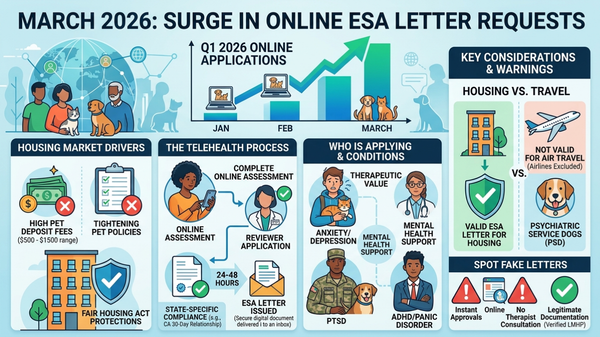
At the same time, individual states have been moving in their own directions. California, Iowa, Arkansas, Louisiana, and Montana now require a minimum 30-day therapeutic relationship between the client and the mental health professional before an ESA letter can be issued. Other states are considering similar rules. The patchwork of state regulations means that a one-size-fits-all approach to ESA letters simply does not work anymore.
How RealESALetter.com Has Responded to Policy Uncertainty
When federal guidance gets pulled back and state rules become more complicated, the burden of compliance shifts to the service provider. RealESALetter.com has responded by building a system that does not rely on guidance documents to stay legitimate. It is built directly on the requirements of the Fair Housing Act and tailored to meet each state's specific rules.
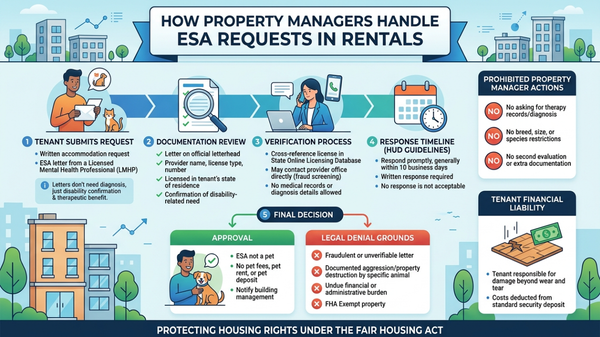
Every client is matched with a licensed mental health professional who holds an active license in the client's state of residence. This is not just a policy preference. It is a legal requirement in most states, and it is one of the things that separates a letter that will hold up from one that will be rejected. After the HUD guidance withdrawal, housing providers are looking more carefully at ESA documentation, not less. Having a letter from a verifiable, state-licensed professional is the strongest protection a tenant can have.
The ADA National Network notes that even without detailed federal guidance, courts have consistently held that housing providers may request reliable documentation from a healthcare provider confirming both the presence of a disability and the disability-related need for the animal. A letter from RealESALetter.com is built to meet exactly that standard, with all required elements present and verifiable.
Setting a Standard for What a Legitimate ESA Letter Looks Like
One of the most important contributions RealESALetter.com is making to the broader ESA conversation is simply demonstrating what a legitimate service looks like. When someone understands what a real ESA letter looks like, they can immediately spot the difference between a properly issued document and one that was generated by an automated form with no clinical oversight.
A valid ESA letter includes the provider's name, license type, license number, and state of issuance. It is written on professional letterhead. It contains a clear statement that the client has a qualifying mental or emotional health condition and that an emotional support animal is part of their treatment plan. It references the Fair Housing Act and is signed by the professional who conducted the evaluation.
RealESALetter.com has been consistent about all of these elements since it began. As landlords and housing providers grow more sophisticated about verifying documentation, letters that meet this standard will be accepted with far less friction. Letters that do not meet this standard will increasingly be rejected outright. By holding the line on quality, RealESALetter.com is helping raise the floor for what the industry accepts as legitimate.
Adapting to State-Level Changes Like California AB 468
One of the clearest examples of how RealESALetter.com is adapting to policy shifts is its compliance with California's AB 468 law. Understanding California AB 468 and the 30-day rule is essential for anyone seeking an ESA letter in that state, because failing to meet the law's requirements means the letter will not be legally valid, no matter how professional it looks.
AB 468 requires that the mental health professional issuing an ESA letter must have established a real therapeutic relationship with the client for at least 30 days before the letter can be written. The professional must be licensed in California. The letter must meet specific content requirements. And the professional must explain the difference between an ESA and a service animal in writing.
These requirements exist because California was seeing a significant number of fraudulent ESA letters issued by out-of-state or unlicensed providers. RealESALetter.com adapted its California process to comply fully with AB 468, connecting California residents with California-licensed professionals and building in the required therapeutic timeline. This kind of state-level responsiveness is exactly what responsible providers need to do, and it sets a model for how other services should operate as more states adopt similar rules.
Fighting Fraud by Refusing to Participate In It
Perhaps the most direct way RealESALetter.com is influencing the future of ESA policy is by refusing to take shortcuts. Approximately 15 percent of ESA letter requests through the platform are turned down. Understanding why some ESA letter requests are turned down helps explain why this matters so much at a policy level.
Requests are declined when the person does not have a qualifying mental health condition, when the animal is not appropriate for the situation, or when the documentation does not meet the clinical and legal standards required. This is not a business decision to minimize risk. It is an ethical decision to protect the integrity of the entire ESA system.
When fraudulent letters flood the market, it creates real consequences for people with genuine needs. Landlords become skeptical of all ESA documentation. Housing providers push for stricter verification. Policymakers face pressure to tighten regulations. Every fake letter that gets issued makes it harder for people with real qualifying conditions to get the accommodation they are legally entitled to.
By maintaining strict standards and declining inappropriate requests, RealESALetter.com is doing something that matters well beyond its own client base. It is protecting the credibility of the entire ESA letter process. That has a direct impact on policy, because regulators and legislators pay attention to fraud rates and abuse patterns when deciding how tightly to restrict ESA documentation requirements.
Why Quality Documentation Matters More Than Ever After HUD's Withdrawal
The withdrawal of HUD's ESA guidance in September 2025 has left many tenants wondering whether their rights have changed. They have not, but navigating those rights has become more complicated.
As Leading Age reported, the HUD memo withdrew guidance documents ranging from 2007 to 2024, covering areas including service animals and assistance animals in housing. The intent was to reduce what HUD described as compliance burdens not found in the statute itself. But the practical effect is that both tenants and housing providers are now operating without the detailed step-by-step framework that had guided ESA requests for years.
In this environment, the quality of your ESA documentation becomes your primary protection. A letter that clearly identifies a qualifying disability, explains the disability-related need for the animal, and is signed by a verifiable, state-licensed professional is far more likely to be accepted and far less likely to be challenged. RealESALetter.com issues exactly this kind of documentation, and it does so in a way that can withstand scrutiny even in the absence of federal guidance.
The U.S. Department of Housing and Urban Development still recognizes that individuals with disabilities may request to keep an assistance animal as a reasonable accommodation under the Fair Housing Act. That right has not gone away. What has changed is the level of clarity around how housing providers should evaluate those requests. Strong documentation fills that gap.
What This Means for the Future of ESA Policy
The direction of ESA policy in America over the next several years will be shaped by a few key forces: the level of fraud in the ESA letter market, the quality of documentation that tenants present, how courts interpret Fair Housing Act requirements in the absence of detailed federal guidance, and how individual states choose to regulate the letter-issuing process.
RealESALetter.com is positioned to have a positive influence on all of these factors. By issuing only legitimate letters backed by real clinical evaluations, it reduces the fraud rate among its own clients. By producing documentation that meets the highest evidentiary standards, it gives tenants a stronger position when housing providers push back. By adapting to state-level requirements, it models what compliance looks like in a fragmented regulatory environment.
There is also a broader public education role at play. Every client who goes through the RealESALetter.com process learns what a legitimate ESA letter requires. They learn that it is not an instant purchase. They learn that a licensed professional must actually evaluate them. They learn that their letter needs to meet specific content requirements to have legal standing. That understanding, multiplied across tens of thousands of clients, gradually shifts public expectations about what ESA documentation should involve.
A Service Built for Where Policy Is Headed
ESA policy in America is moving toward stricter standards, greater accountability, and more careful scrutiny of documentation. That is the right direction, and RealESALetter.com has been operating in that direction from the start.
As federal guidance becomes less prescriptive and state rules become more varied, the services that will continue to serve their clients well are the ones that have always prioritized clinical integrity over convenience. RealESALetter.com has built its entire model around that principle. The letters it issues are not just pieces of paper. They are legally defensible documents backed by real evaluations from real licensed professionals.
For the millions of Americans who rely on emotional support animals to manage qualifying mental health conditions, having access to a trustworthy, compliant, and professionally run ESA service is not a luxury. It is how they protect their housing rights in a policy environment that is still finding its footing. RealESALetter.com is helping to define what responsible ESA documentation looks like, and that work matters more right now than it ever has before.