How Property Managers Handle ESA Requests in Rentals

When a tenant submits an ESA letter along with a reasonable accommodation request, property managers follow a process that is part legal requirement, part documentation review, and part tenant relations. Knowing exactly what steps property managers take helps tenants prepare better documentation, reduce delays, and protect their housing rights under the Fair Housing Act. This is not an informal process, and the outcome is determined largely by the quality and completeness of the documentation submitted from the start.
ESA accommodation requests in rental housing have grown significantly over the past decade. What was once a rare situation has become a routine part of property management across the country, from large apartment complexes with dedicated legal teams to small landlords handling a handful of units. With that growth comes both clearer federal guidance and stricter scrutiny of submitted documentation. Property managers today are more familiar with what a valid emotional support animal letter looks like, and they are also more familiar with what fake or insufficient documentation looks like.
Understanding how property managers evaluate an ESA letter for housing, what they are legally permitted to request, and what they are prohibited from doing puts tenants in a stronger position from the start. This guide covers the full process from submission to approval, including what makes documentation hold up, what gives a property manager grounds to deny a request, and what tenants can do when the process goes wrong.
The Initial Accommodation Request: What Property Managers Expect
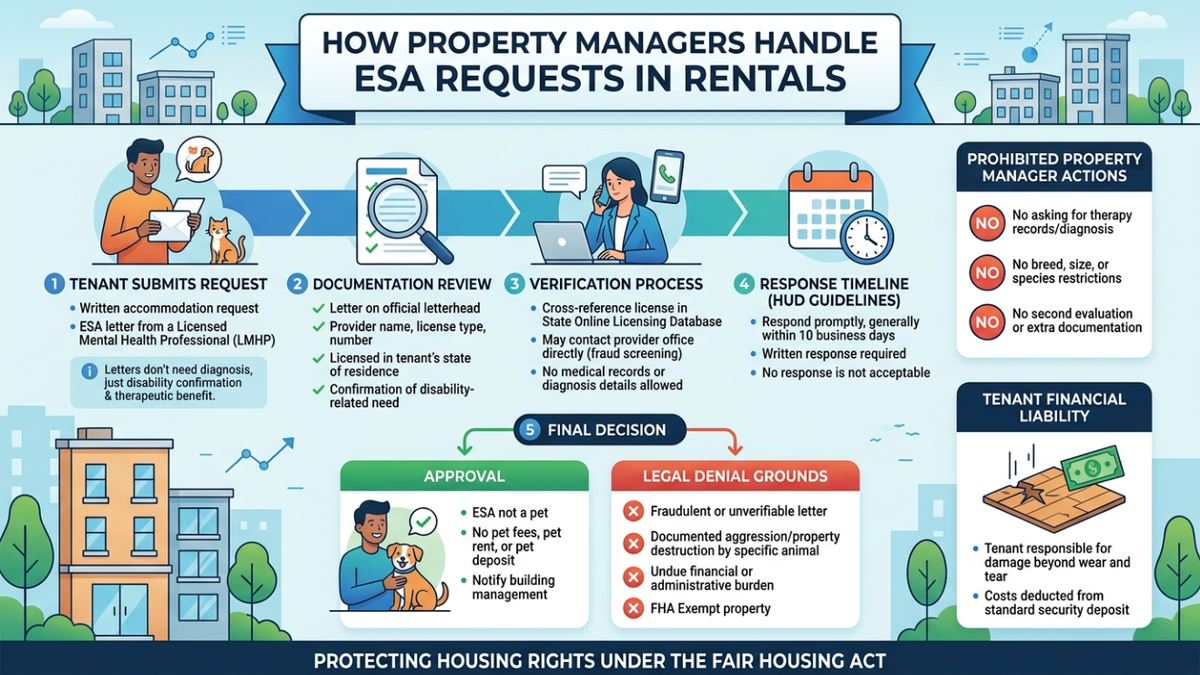
The formal process starts with a written reasonable accommodation request. Property managers expect this request to include a valid ESA letter from a licensed mental health professional along with a brief statement confirming the accommodation is needed due to a disability. The letter does not need to specify the tenant's diagnosis. It only needs to confirm that a licensed provider has recommended the animal as part of the tenant's treatment or emotional support plan.
Larger apartment complexes often have standardized intake forms for ESA accommodation requests. These forms typically ask for the provider's name, license number, and contact information so the property management team can verify credentials. Smaller properties handle the process less formally, but the core documentation requirement remains the same: a signed letter on official letterhead from a state-licensed mental health professional.
Tenants who submit their ESA letter proactively, before or during the application process rather than after signing a lease, tend to experience faster approvals and less friction. Early submission signals transparency and reduces the suspicion that an ESA request is an afterthought intended to get around a no-pets policy.
Key elements property managers look for when they first receive a request:
- A letter on official letterhead with the provider's name, license type, and license number
- Confirmation that the provider is licensed in the tenant's state of residence
- A statement that the tenant has a disability and that the animal provides therapeutic benefit
- Provider contact details for verification
How Property Managers Verify an ESA Letter
Verification is the most critical step in the review process. Once a property manager receives an ESA letter, they cross-reference the provider's license number against the relevant state's online licensing database. Most states make this information publicly available, so a property manager can confirm within minutes whether the professional who signed the letter holds an active, valid license in that state.
Some property managers contact the provider's office directly to confirm that the letter was actually signed by that professional. This step is common in larger rental communities where the volume of ESA requests makes fraud screening routine. A properly issued emotional support animal letter from a legitimate provider always holds up to this verification because the issuing professional's credentials are publicly checkable.
Property managers cannot ask for medical records, diagnosis details, or treatment notes. Federal fair housing rules prohibit housing providers from requiring tenants to disclose the specific nature of their disability. The ESA letter is the only document a housing provider can legally request.
Red flags that trigger extra scrutiny during verification:
- Letters from providers not licensed in the tenant's state
- Generic, heavily templated letters with no personalized tenant information
- Providers whose licenses cannot be found in state databases
- Letters from platforms offering instant approval without a real clinical evaluation
Response Timelines and What Happens After Submission
Under HUD guidance, housing providers are expected to respond to ESA accommodation requests promptly, generally within 10 business days of receiving documentation. This timeline prevents property managers from dragging out review in ways that effectively deny an accommodation without formally rejecting it. Tenants who receive no response within that window have grounds to follow up in writing and document the delay as part of any potential fair housing complaint.
Once the ESA letter passes verification, the property manager formally approves the accommodation. The tenant is no longer subject to the property's no-pets policy for their ESA. The animal cannot be charged pet fees, pet rent, or a separate pet deposit. The approval is typically documented in writing and filed with the lease records. In apartment buildings where an on-site leasing agent handles day-to-day operations, the agent notifies building management so the ESA is recognized across the property, including common areas like lobbies and elevators.
Larger operations with dedicated legal teams may route all ESA approvals through that department before responding to the tenant. This can push the timeline toward the full 10-day window but remains within HUD guidelines as long as the final response arrives within that period. In cases where a property manager needs more time to evaluate a genuinely complex request, they are required to communicate that delay in writing and provide a reason. Silence is not acceptable under federal fair housing guidelines and exposes the housing provider to HUD complaints.
When a Property Manager Can Legally Deny an ESA Request
Property managers can push back on ESA requests under specific circumstances allowed by federal law. For tenants who have not yet submitted a request, working with the best place to get an esa letter means documentation is complete enough to withstand scrutiny and removes documentation-based grounds for denial.
Legal grounds for denying an ESA accommodation request:
- The ESA letter is fraudulent, incomplete, or cannot be verified against state licensing records
- The specific animal has a documented history of biting, aggression, or serious property destruction
- Accommodating the animal would impose an undue financial or administrative burden on the property
- The property qualifies for a Fair Housing Act exemption, such as owner-occupied buildings with four or fewer units
What property managers cannot do is deny an ESA based on breed, size, or species. The Fair Housing Act explicitly prohibits applying standard pet restrictions to emotional support animals. Illegal denials can result in federal civil penalties starting above $25,000 for a first violation, plus compensatory damages and the tenant's attorney fees. Property managers also cannot require any documentation beyond the ESA letter itself; requesting therapy notes or a second evaluation is a violation of tenant privacy rights.
Fees, Deposits, and Tenant Damage Responsibility
Once an ESA accommodation is approved, property managers cannot charge any fees related to the animal's presence, including pet deposits, monthly pet rent, or application fees tied to the ESA. Emotional support animals are classified as assistance animals under the Fair Housing Act, not as pets, which is why standard pet fee policies do not apply.
However, the no-fees rule does not mean zero financial responsibility for the tenant. If an ESA causes damage beyond normal wear and tear, the property manager can charge for repairs. These costs are deducted from the standard security deposit. If damage exceeds that amount, the property manager can pursue the balance through normal legal channels. The financial liability for ESA damage functions identically to general tenant damage liability under any standard lease.
What Makes an ESA Letter Hold Up Under Review
The quality of an ESA letter determines how smoothly a tenant moves through the property manager's verification process. Understanding who can write an ESA letter that meets all verification requirements is the foundation of a successful submission. Letters that pass review without complications share a consistent set of features: they are issued by a professional who is actively licensed in the tenant's state, they include every required credential detail, and they are personalized to the specific tenant rather than using a generic template.
Property managers also pay close attention to whether a letter appears mass-produced. Templates that are clearly designed to generate volume, with no individual reference to the tenant's circumstances, attract extra scrutiny during verification. A letter that references the tenant by name, confirms the therapeutic relationship, and includes verifiable provider credentials moves through the review process with the least resistance.
A valid ESA letter that holds up under property manager review includes:
- The provider's full name, title, license number, license type, and state of licensure
- Official practice letterhead with address and contact information
- A statement confirming the tenant has a qualifying disability under the Fair Housing Act
- A recommendation for an emotional support animal as part of the tenant's support plan
- The issuance date and provider's original signature
A missing license number is the single most common documentation gap that slows approvals. Without it, property managers cannot run a state database check, and many will request clarification before moving forward. A complete letter bypasses that delay entirely.
Frequently Asked Questions
Can a property manager request more than the ESA letter?
No. Federal fair housing rules limit housing providers to requesting only the ESA letter as proof of need. Asking for therapy records, diagnosis notes, or any additional medical documentation beyond the signed letter from a licensed mental health professional is a Fair Housing Act violation. Property managers are also not permitted to require registration with any pet registry or certification service, as these are not recognized under federal housing law. Tenants facing this situation can document the request and file a formal complaint with HUD or a local fair housing office.
What if a property manager ignores an ESA request?
HUD guidelines require housing providers to respond within 10 business days. A property manager who does not respond can face a formal fair housing complaint filed with HUD, which treats documented non-response similarly to an illegal denial. Tenants should always submit ESA requests in writing, either by email with read receipt or by certified mail, so there is a clear documented submission date. Following up in writing after the 10-day window closes creates additional documentation that strengthens any complaint.
Can a property manager deny an ESA based on breed or size?
No. The Fair Housing Act prohibits applying breed restrictions, weight limits, or size caps to emotional support animals. These restrictions apply to regular pets, not to ESAs. A property manager who rejects an ESA accommodation solely because of the animal's breed or size is in direct violation of federal law. First-offense federal civil penalties start above $25,000, and successful tenants in fair housing cases can also recover compensatory damages and attorney fees from the housing provider.
Are tenants responsible for ESA damage?
Yes. The no-fees protection does not eliminate damage responsibility. If an ESA causes property damage beyond normal wear and tear, repair costs are deducted from the standard security deposit that all tenants pay. Any amount beyond that can be pursued by the property manager through normal legal channels. This liability applies regardless of whether the ESA accommodation was formally approved and functions identically to general tenant damage liability under any standard lease.
The Bottom Line
Property managers follow a defined process when they receive an ESA accommodation request: documentation review, license verification, response within the 10-business-day window, and formal approval. Understanding each step helps tenants submit stronger requests and respond quickly when issues arise.
The quality of the ESA letter is the single most important factor in how smoothly a request moves through that process. A complete, verifiable emotional support animal letter from a state-licensed professional reduces delays, eliminates documentation-based denial grounds, and protects housing rights under the Fair Housing Act from the moment of submission.