Can a Landlord Deny an Emotional Support Animal? Your Rights Under the Fair Housing Act

The short answer is no, with narrow exceptions. Under the Fair Housing Act, a landlord cannot deny an ESA to a tenant who provides valid documentation from a licensed mental health professional confirming a disability-related need for the animal. The FHA classifies emotional support animals as assistance animals rather than pets, which means that no-pet policies, breed bans, weight limits, and pet fee structures do not apply to properly documented ESAs. Landlords who deny valid accommodation requests face federal fair housing complaints, DOJ enforcement actions, and financial penalties that can reach hundreds of thousands of dollars.
But the reality in 2026 is more complicated than the law suggests on paper. Landlords deny ESA requests every day, sometimes legally and sometimes not. Property managers cite direct threat concerns, question the legitimacy of ESA letters, impose documentation requirements that exceed what the law allows, or simply ignore requests until the tenant gives up. Knowing exactly when a landlord cannot deny an ESA and when a denial is legally justified is what separates tenants who keep their housing protections from those who lose them.
This guide covers the specific FHA rules that protect ESA owners, the limited circumstances where landlords can legally deny a request, the most common illegal denial tactics that tenants encounter in 2026, what to do when a denial is unlawful, and how documentation quality determines the outcome in almost every disputed case.
What the Fair Housing Act Requires From Landlords
The Fair Housing Act prohibits housing discrimination against individuals with disabilities, including those who rely on emotional support animals as part of their treatment plan. Under the FHA, landlords and property managers must provide reasonable accommodations for tenants with ESAs. This obligation applies to private rentals, condominiums, HOA-governed communities, Section 8 housing, federally subsidized properties, and university dormitories. The only housing exempted from FHA coverage is owner-occupied buildings with four or fewer units and single-family homes rented without a real estate agent.
The FHA treats emotional support animals as assistance animals, not as pets. This classification carries specific legal consequences that landlords must follow. When a tenant submits a valid ESA letter, the animal shifts from being subject to the property's pet policies to being protected under federal disability law. This distinction is the foundation of every ESA housing dispute.
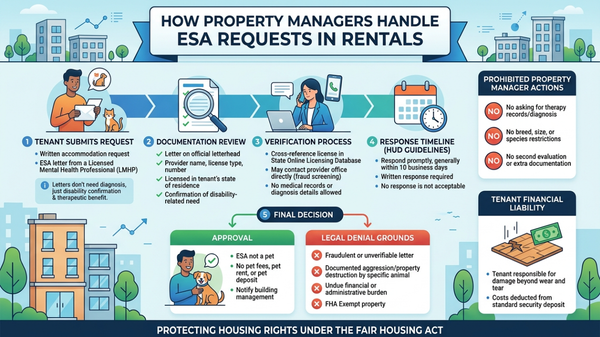
- No pet deposits or fees: a landlord cannot deny an ESA accommodation by imposing financial barriers. This means no pet deposits, no monthly pet rent, no application fees tied to the animal, and no breed-specific surcharges. Landlords can still hold tenants liable for actual property damage through the standard security deposit that applies to all residents
- No breed, size, or weight restrictions: even in buildings that ban specific breeds or enforce weight caps for regular pets, those restrictions do not apply to emotional support animals with valid documentation. A landlord who denies an ESA accommodation based on the animal's breed is violating the FHA regardless of what the property's pet policy states
- No training requirements: unlike service dogs, which must be trained to perform specific tasks, emotional support animals are not required to have any specialized training under New Jersey ESA laws or any other state's regulations. The animal's value comes from its therapeutic presence, not from task performance
- 10-day response window: HUD guidelines require landlords to respond to ESA accommodation requests within 10 days. Stalling, ignoring, or indefinitely delaying a response is itself a form of discrimination that tenants can report
These protections apply in every state. Whether a tenant rents in Illinois, Pennsylvania, or Arizona, the FHA provides the same baseline rights. Some states add further protections, but no state can reduce the federal floor.
When a Landlord Can Legally Deny an ESA Request
While the general rule is that a landlord cannot deny an ESA, the FHA does allow denials under a small number of specific, fact-dependent circumstances. These exceptions are narrow, and the burden of proof falls on the landlord to demonstrate that the denial is justified through an individualized assessment rather than a blanket policy. Landlords who deny ESA requests must be able to articulate specific, documented reasons tied to one of the following categories.
- Direct threat to health or safety: a landlord can deny an ESA if the specific animal (not the breed or species) poses a verified, direct threat to the health or safety of other residents that cannot be reduced through reasonable measures like training, leashing, or muzzling. This determination must be based on objective evidence about the individual animal's behavior, not on assumptions, breed stereotypes, or generalized fears about certain types of animals
- Substantial property damage: if the specific animal has a documented history of causing significant property damage that exceeds normal wear and tear, and no reasonable mitigation measures can address the risk, the landlord may deny the accommodation. Again, this must be an individualized assessment based on evidence about the particular animal, not a categorical rule about species or size
- Unreliable documentation: a landlord can question an ESA request if the documentation does not come from a licensed healthcare provider with personal knowledge of the tenant's condition. Letters from unlicensed individuals, online registration mills, or providers with no genuine therapeutic relationship may be rejected. However, the landlord must engage in a good-faith interactive process before denying the request, and legitimate telehealth evaluations produce valid documentation that landlords must accept
- Undue financial or administrative burden: in rare cases, a landlord can deny an accommodation if granting it would impose an undue financial or administrative burden on the housing provider. This exception is extremely difficult to establish and almost never applies to standard ESA requests. It is more commonly invoked in cases involving unusual animal species or multiple large animals in small units
- Exempt housing types: owner-occupied buildings with four or fewer units and single-family homes rented without a broker are exempt from the FHA. Landlords operating these properties are not legally required to accommodate ESAs, though some state and local laws may still apply
Common Illegal Reasons Landlords Use to Deny ESAs
Despite clear federal law, tenants encounter illegal ESA denials regularly. Property managers who are unfamiliar with the FHA, hostile toward ESA accommodations, or confused by the September 2025 HUD guidance withdrawal frequently cite reasons that have no legal basis. A 2024 HUD report found that disability-related housing complaints, including ESA denials, represented over 60% of all fair housing complaints filed nationally. Every reason listed below is a violation of the Fair Housing Act, and tenants who receive these denials should push back immediately.
- Our building has a no-pet policy: ESAs are not pets under the FHA. No-pet policies do not apply to assistance animals with valid documentation. A landlord cannot deny an ESA by pointing to a general pet prohibition
- We do not allow that breed: breed bans apply only to standard pets, not to emotional support animals. Even breeds commonly restricted by insurance policies (pit bulls, Rottweilers, German Shepherds) must be accommodated when supported by valid ESA documentation. Tenants in states with specific breed protections can reference resources covering Michigan ESA laws and Colorado ESA laws for additional guidance
- Your animal is too large for this unit: weight limits and size restrictions apply to pets, not ESAs. A landlord cannot set a weight cap and use it to deny an ESA that exceeds the limit
- We need to see your medical records: landlords cannot demand specific diagnosis information, medication lists, therapy session notes, or other private medical details. The ESA letter confirms a disability-related need without disclosing the diagnosis. Any landlord demanding health records beyond the letter itself is overstepping federal law
- You need to register or certify your ESA: no government ESA registry exists. Landlords who require registration cards, certification badges, ID vests, or similar products as a condition of granting an accommodation are imposing a requirement that the FHA does not allow
- Our insurance does not cover this animal: insurance policy limitations do not override federal fair housing obligations. A landlord cannot use insurance restrictions as grounds to deny an ESA accommodation
What to Do When a Landlord Wrongfully Denies an ESA
Tenants who receive an unlawful ESA denial should take specific steps to protect their rights and create a record that supports a formal complaint if necessary.
- Request the denial in writing: ask the landlord to provide the specific reason for the denial in writing. This creates a documented record that can be used in a HUD complaint or legal proceeding. Many landlords who deny ESAs verbally will not put their reasoning in writing once they realize it does not hold up under the law
- Engage in the interactive process: HUD encourages both parties to work through a good-faith dialogue called the interactive process before any final decision is made. Tenants can offer solutions that address the landlord's specific concerns (such as providing proof of the animal's vaccinations, agreeing to a waste cleanup plan, maintaining renter's insurance, or offering to pay for any actual damage) without giving up the accommodation itself. This dialogue often resolves disputes without needing to escalate to a formal complaint
- Review and update the ESA letter: if the landlord questions the documentation, tenants should confirm that the letter includes every required element: the provider's name, license type, license number, state of licensure, contact information, professional letterhead, the date of issuance, and a statement tying the disability to the need for the animal. A letter from a provider who issues ESA letters in Maryland or any other state should meet these standards
- File a HUD complaint: tenants can file a housing discrimination complaint with HUD's Office of Fair Housing and Equal Opportunity online at hud.gov, by phone at 1-800-669-9777, or by mail. The complaint must be filed within one year of the last discriminatory act. HUD investigates complaints, may offer mediation, and can pursue fines and policy changes against landlords who violate the FHA
- Contact a local fair housing organization: nonprofit fair housing groups in every state provide free guidance and legal assistance to tenants facing ESA discrimination. These organizations can help tenants understand their options, communicate with landlords, and escalate cases when necessary. Tenants in Georgia or Washington state can find state-specific organizations through HUD's website
Why ESA Letter Quality Determines the Outcome
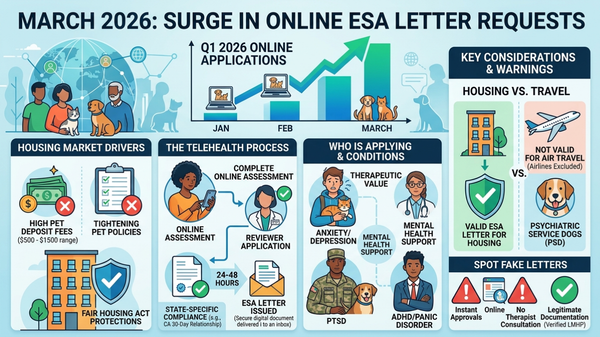
In most disputed ESA cases, the deciding factor is the quality of the documentation. A landlord cannot deny an ESA when the tenant provides a properly formatted letter from a licensed mental health professional who has conducted a genuine clinical evaluation. But landlords can and do reject letters that are obviously fraudulent, missing required information, or issued by providers without proper state licensing. Property management companies in major markets now use third-party verification services that check license numbers against state databases, confirm provider identity, and flag letters that appear to be mass-produced templates.
The difference between a letter that survives landlord scrutiny and one that gets rejected often comes down to specific details: whether the provider's license number is included and verifiable, whether the letter is dated within the past 12 months, whether the provider is licensed in the tenant's state of residence, and whether the document establishes a genuine therapeutic relationship rather than a quick transaction. Tenants who use ESA letters for housing from providers that follow state-specific rules and federal HUD requirements face dramatically lower rejection rates than those who use discount services that skip clinical evaluations.
In 30-day relationship states (California, Oregon, Arkansas, Iowa, Louisiana, and Montana), the documentation requirements are even stricter. Letters issued without the required 30-day provider-patient relationship and dual consultations are invalid under state law, giving landlords a legitimate basis for denial. Tenants in these states must plan ahead and use providers that build state compliance into the process from the start.
Frequently Asked Questions
Can a landlord deny an ESA in a no-pet building?
No. Under the Fair Housing Act, emotional support animals are classified as assistance animals rather than pets. No-pet policies do not apply to ESAs with valid documentation. A landlord cannot deny an ESA simply because the property has a pet prohibition.
Can a landlord charge a pet deposit for an emotional support animal?
No. Landlords cannot charge pet deposits, monthly pet rent, application fees, or any other financial charges connected to an emotional support animal. They can charge the tenant for actual property damage through the standard security deposit that applies to all residents, but they cannot impose ESA-specific fees.
What happens if a landlord denies a valid ESA request?
Tenants can file a housing discrimination complaint with HUD within one year of the denial. HUD investigates complaints, offers mediation, and can impose fines and require policy changes. The Department of Justice can also pursue enforcement actions against landlords who show patterns of FHA violations, with financial penalties that have reached $750,000 in recent cases.
Can a landlord ask what my disability is?
No. When the disability is not obvious, the landlord can ask for documentation confirming that the tenant has a disability-related need for the animal. But the landlord cannot demand the specific diagnosis, request medical records, ask about medications, or require the therapist to disclose detailed clinical information. The ESA letter confirms the need without identifying the condition.
Where can tenants get a valid ESA letter that landlords will accept?
The best site for emotional support animal letter documentation is one that employs state-licensed therapists, conducts genuine clinical evaluations, complies with 30-day relationship state requirements, and delivers letters with all required elements for landlord verification. RealESALetter.com meets every one of these criteria, with a network of therapists licensed in all 50 states, a 100% money-back guarantee, BBB accreditation with an A+ rating, and over 15,000 letters issued. Tenants can also review ESA letter requirements for New York or any other state to confirm what their specific documentation must include.
Conclusion
The Fair Housing Act is clear: a landlord cannot deny an ESA when a tenant provides valid documentation from a licensed mental health professional. The exceptions are narrow, evidence-based, and focused on the specific animal rather than on breed stereotypes, building pet policies, or landlord preferences. Tenants who understand these boundaries, maintain current documentation, and know how to respond to unlawful denials are in the strongest position to protect their housing rights.
The single most effective thing any tenant can do is start with a high-quality ESA letter that meets every federal and state requirement. Documentation that includes proper therapist credentials, a current date, state-specific compliance, and a clear connection between the disability and the animal's therapeutic role gives the landlord no legitimate grounds for denial. In an environment where property managers are scrutinizing ESA requests more closely than ever, the quality of the letter is the difference between a smooth accommodation and a legal dispute that neither party wants.